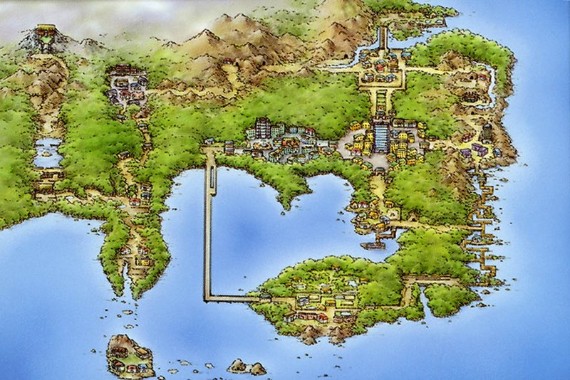
Kanto: a large area located east of Johto, north-east of Hoenn, and south of Sinnoh. It is the first region to be introduced, explored in the Generation Igames and in the Generation III games Pokémon FireRed and LeafGreen Versions. Kanto is also accessible in the Generation II games Pokémon Gold, Silver, and Crystal and their Generation IVremakes after the quest in Johto is completed. It is the only region to appear in all Generations so far released.
Most of the names of the cities in Kanto are the names of colors (Viridian, Lavender, Indigo Plateau, etc.). Professor Oak is the resident Pokémon professor and gives Pokémon Trainers a choice betweenBulbasaur, Charmander, or Squirtle as their starter Pokémon, though in Yellow the only choice is aPikachu that he recently caught, although he did have an Eevee. In the games, the player begins his or her journey in Pallet Town and ends it at the Indigo Plateau.
It is based on and named after the real Kantō region (関東, meaning "east of the barrier") in Japan. Unlike almost every other region, which are specific to their own generations, Kanto has been explorable in all generations of Pokémon games so far. However, it is not the primary region in the Generation II and IV games it appears in, in which players explore the neighboring Johto region before exploring Kanto.
The artwork of Kanto in Generation I and Generation II depict Kanto as grassland, with very few trees. InGeneration III and Generation IV, Kanto is seen with more trees, making it less like grassland.
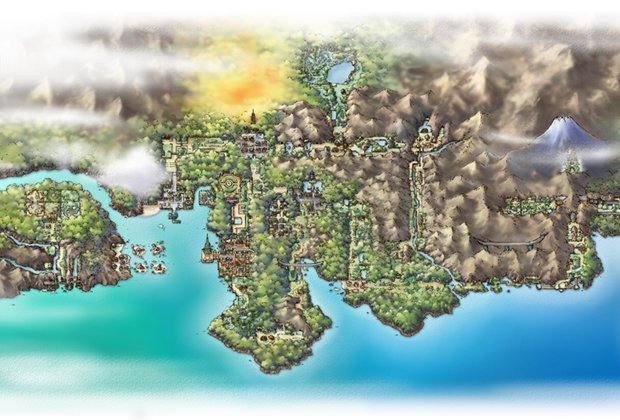
Jhoto:a large area located west of Kanto. Johto and Kanto are part of a large landmass, with everything west of Indigo Plateau falling in the Johto region. Though it is unlike Kanto in that its name is not directly based on that of a region of Japan, Junichi Masuda has come forward in his director's column naming the kanji that inspired the name mean "castle palace" (城都) or "lattice-shaped palace" (条都); this meaning is connected to the city of Nara, which was the basis for Violet City.
First explored in Pokémon Gold and Silver, it is home to an additional 100 Pokémon that were not present in previous games. In the Generation II games and their remakes, players begin their journey inNew Bark Town, where Professor Elm offers either Chikorita, Cyndaquil or Totodile to beginningPokémon Trainers. The English-version names of most of the cities in Johto are also the names of plants or things related to plants.
.jpg)
Hoenn: a large region to the southwest of Johto, and resembles the real-world Japanese main island of Kyushu. It is the setting of theGeneration III games Pokémon Ruby, Sapphire, and Emerald. The names of most of the cities in Hoenn are made of two words put together (Little Root, Fort Tree, Slate Port, Ever Grande, etc.) rather than colors as Kanto and Johto had done. Professor Birch of Littleroot Town offers the Starter Pokémon known as Treecko, Torchic, or Mudkip to trainers beginning their journey of this vast land.
Junichi Masuda has stated that Hoenn's name comes from 豊縁, hōen, meaning "abundant relations", as a common theme in this region is the relationships forged between Pokémon and people. He also stated that the reasoning behind rotating Hoenn 90° counterclockwise compared to its real-world counterpart was to increase playability[1].
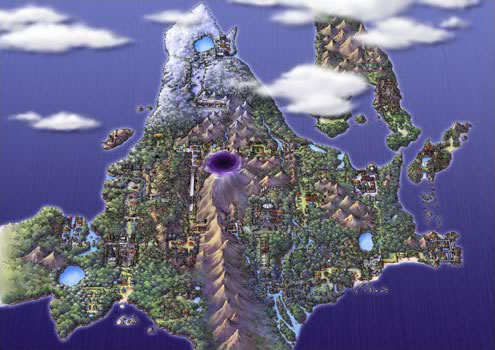
Sinnoh:an area in the Pokémon world, comprising of the large mainland, the north-eastern island of the Battle Zone, and numerous smaller islands on the eastern side. The Sinnoh region is currently the north-most region known, and is neighbors to the Kanto and the Johto regions to the west, and the Almia region to the south. It is far away from Isshu.
This region is the setting of the Generation IV games Pokémon Diamond, Pearl, and Platinum. Sinnoh has both new and traditional geographic features for the player to explore, including snowy and foggy routes. Most of its routes are on land; the region is Mt. Coronet, roughly comparable to how the continent that Kanto and Johto make up is essentially a contiguous region.
It is based on the geography of the Japanese island of Hokkaido and southern part of the Russian island of Kunashir. Most of the cities and towns in Sinnoh, as well as the region's design, draw from these real-world locations. The Japanese name of Shin'ō is possibly derived from the Sino-Japanese phrase 深奥, which can be translated to as "mysteries". The name can also be connected to 神 shin, "god" or "deity", and 神話 shinwa, "myth".
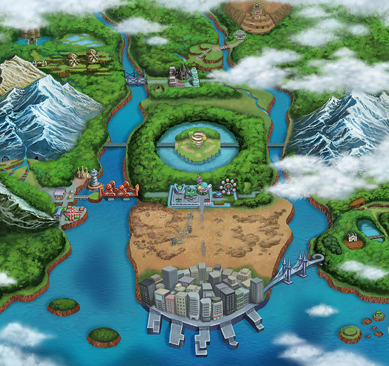
Isshu: a large area of the Pokémon world and the setting of the fifth generation Pokémon gamesPokémon Black and White. It is far away from the four other large regions, and the Pokémon which inhabit Isshu are diverse and different from those of Kanto,Johto, Hoenn, and Sinnoh. In his director's column,Junichi Masuda suggested that the geographical and social background for Isshu draws inspiration from theNew York City metropolitan area, although the region features rural locations as well as industrial.
Isshu features fifteen settlements which reflect the diversity of the region. Hiun City, a sprawling metropolis, is the largest city in any known Pokémon region. Kanoko Town, which is inhabited by the Pokémon expert Professor Araragi, is smaller and quieter. Black City is a version-exclusive city found only in Pokémon Black. Isshu's landscape also features several forests (one of which, White Forest, is also version-exclusive), a desert, a magnetic caveand areas where the move Dive can be used outside of battle. Although Isshu appears in some ways more technologically advanced than the previous regions, this development is not spread across the whole of the region.
These towns and cities are connected by a network ofroutes. These are numbered from 1 to 18, mimicking the naming scheme used in Kanto and emphasizing Isshu's isolation. Isshu has the least numbered routes of any region, but also has named routes stretching between settlements. These include five bridges and asubway network.
Unlike previous regions, where climatic change was experienced locally (that is to say, some routes would always feature snow, and some routes would always feature rain), Isshu is susceptible to national seasonal change. Spring, summer, autumn and winter each last approximately thirty days, and recur three times each within a year. Each season brings with it different weather patterns, unlocks different events, and presents altered Pokémon availabilities.
Here are some of the mini poke regions.

Sevii Islands- an archipelago of nine large islands and several small islands surrounding them far south of Kanto, and are home to several legendary Pokémon. They resemble the real-life Izu Islandsand Bonin Islands. Their only game appearance was in Pokémon FireRed and LeafGreen, but they have appeared in various other media based on these games.
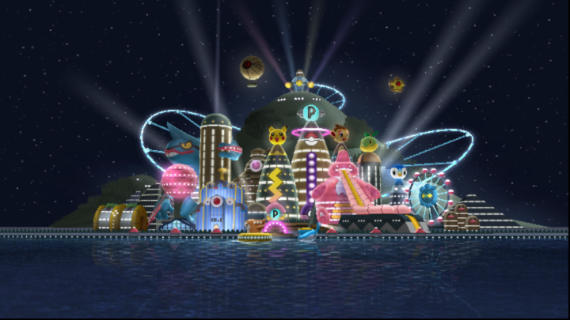
Poketpia- the large city where Pokémon Battle Revolution takes place. Aside from having all the normal facilities of a city, such as streets, buildings and a harbor, Pokétopia is also home to ten different Colosseums, each with their different rules and a leader to run those facilities. In this, it is highly similar to the Battle Frontier, albeit larger.
The design of the technologically advanced city is very similar to LaRousse City.
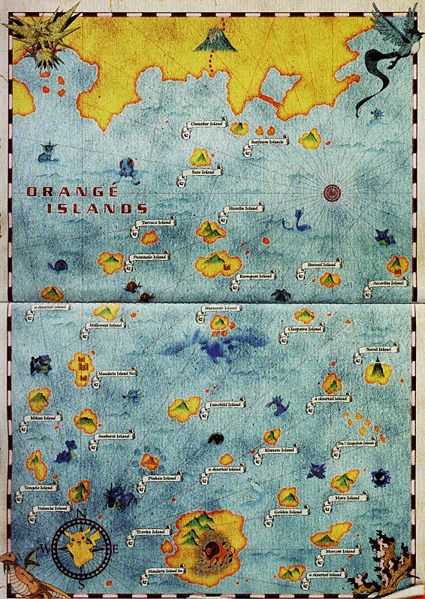
Orange Islands- a large chain of tropical islands shown in theanime that is located south of the Kanto region. Pokémon Trainers come here to participate in the Orange League, but its tropical climate also attracts many tourists. One effect of the climate is the presence of alternately colored Pokémon.
Most of the scattered islands in the archipelago are named after types of oranges (or other various citrus), but many are deserted.
The Officer Jennys and Nurse Joys of the archipelago dress in slightly different attire than those of the other regions. Some also appear to have tans.
This region appears only in the anime and the Electric Tale of Pikachu manga. It is not accessible in any of the games.
